
Have you ever bought a product on Amazon because of glowing five-star reviews, only to feel disappointed later? You are not alone. Fake reviews are everywhere. They look real. They sound convincing. But they can mislead buyers and waste money.
At Trusted Reviews Hub, we believe informed buyers make smarter choices. Our goal is simple. We provide honest, unbiased, and expert insights to help you shop confidently on Amazon. In this guide, you will learn how to identify fake reviews before you click the “Buy Now” button.
Why have fake reviews become a growing problem?
Online shopping depends on trust. Reviews play a key role in building that trust. When reviews are genuine, they share real experiences. An online product or service reviews talk about quality, delivery, pros, and cons. However, some sellers try to manipulate ratings. They pay for positive reviews. They create fake accounts. They post misleading feedback to boost sales. This harms customers and honest brands. This is why understanding how fake reviews work is the first step toward avoiding them.
Tips to spot fake reviews about products before you buy
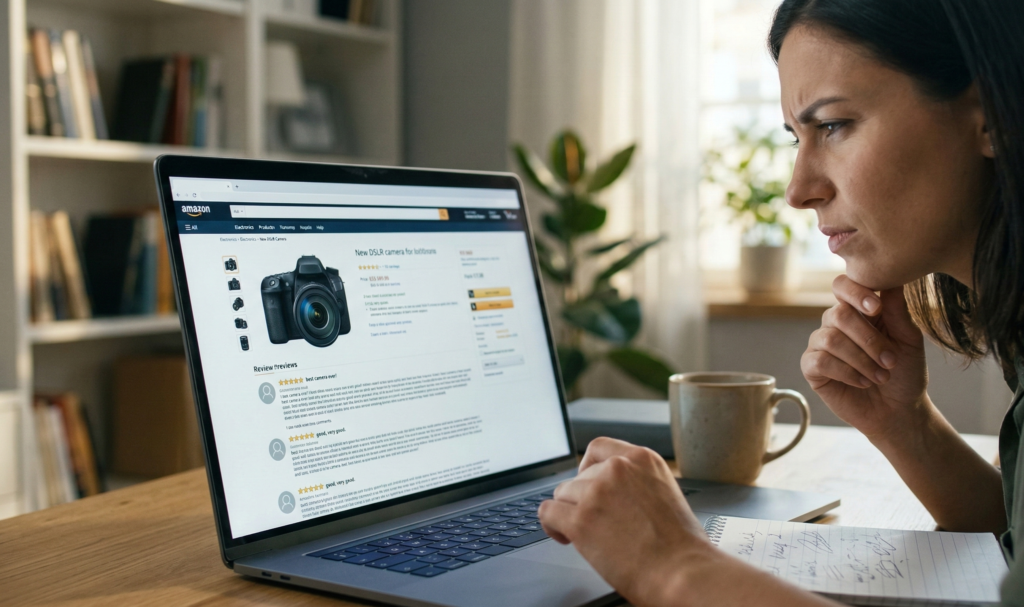
Look after reviews language and style
Fake reviews need to be written in extreme language, such as “best product ever,” “life-changing,” “must buy immediately,” and so on. Genuine reviewers tend to have more balanced views. It contains both good and bad things about the product.
Be cautious of reviews written in the promotional style. If the review contains the product name repeated several times, the review is likely written to promote the product rather than to share the actual experience. Also, look at the similarity in the writing style. If several reviews have similar sentences, the reviews may have been written in bulk.
Check Reviewer’s Profile
Click on the profile of the reviewer. What else has the person reviewed? If the person has reviewed dozens of different products in a short period of time, be cautious. Genuine reviewers tend to have reviewed the product they actually used. Their profile may have several different ratings and comments. If the profile has only five-star ratings for unknown brands, be cautious.
Check the timing of the review
Timing is important in detecting fake reviews. If the product has suddenly gained hundreds of five-star ratings in a short period of time, something is strange. The natural growth of reviews is slow. Clustering of reviews may be an indication of a paid campaign. Also, look for negative reviews from the past and extremely positive reviews in the present. The reviews may have been manipulated.
Focus on verified purchase tags
On Amazon, some reviews are marked as “Verified Purchase.” This means the buyer purchased the product from Amazon.
While this does not necessarily mean the review is genuine, it does give the review more authenticity. However, this does not necessarily mean that non-verified reviews are fake.
Trusted Reviews Hub analyzes the verified and non-verified reviews before providing our expert insights.
Look for detailed personal experience
Genuine reviews contain detailed information on how the product was used. It may contain information on the size, color, and performance of the product, or its package and durability. Another feature of fake reviews is that they tend to be vague. Fake reviews do not provide details. They do not provide any positive feedback. If the review does not provide details about the solution provided by the product for the problem it solves, then the review is fake.
Check for mixed ratings
There is no product in the world that is perfect. All good products face criticism to some extent. If all the ratings for the product are five stars, then it is a fake review.
Balanced ratings provide a genuine level of feedback. Carefully read three-star and four-star ratings. These reviews provide the most accurate feedback.
At Trusted Reviews Hub, we read all the reviews for the product, regardless of the ratings.
Analyze grammar and formatting
Another feature of fake reviews is grammatical errors. Some reviews also tend to have strange formatting. But do not judge the review solely based on this criterion. Some customers can also be ungrammatical. The key is to find common patterns. If there is a pattern among the reviews, then the reviews are fake.
Compare reviews across platforms
Do not solely rely on the reviews provided by a single platform. Go to Google and type the name of the product. If you find consistent feedback across different sources, the information is more reliable. Trusted Reviews Hub helps readers make informed decisions.
Read the negative reviews carefully
Negative reviews can be very helpful. They often highlight hidden issues. However, also check if negative reviews seem copied or unrelated to the product. Sometimes competitors post fake negative feedback. Look for detailed explanations. A genuine complaint usually explains what went wrong. Balanced analysis is essential. Do not ignore criticism. But do not believe every complaint blindly.
Trusted Reviews Hub filter noise, analyze trends, and provide honest evaluations so you can shop with confidence.
How Trusted Reviews Hub guarantees authentic insights?
We follow a clear and ethical review process. Our team studies customer feedback patterns. We evaluate product specifications. We consider brand reputation. We analyze verified purchase data. We do not support paid promotions that sway our opinions. We enlighten readers with factual and unbiased content. When you choose to read from us, we guarantee that we have based our opinions on actual experience and research. Buying online should always be an easy and secure process. With adequate knowledge, however, you will be able to avoid fake reviews and make smart purchasing decisions.
Conclusion
It is easy for fake reviews to sway your purchasing decisions if you are not careful enough. Fake reviews are meant to build anticipation and excitement in your purchasing decisions and create blind trust in certain products. However, if you are careful and keen enough, you will easily notice signs of a fake review.
Smart purchasing decisions are not all about looking for five-star ratings and reviews. It is all about understanding real customer experiences and opinions. When you are keen enough and read customer reviews from different sources, you will minimize your possibilities of regret and buyer’s remorse. At Trusted Reviews Hub, we are committed to making your Amazon purchasing experience safe and secure.
Before making the next purchase, take a step back, think, and assess the situation. Look beyond the stars, ask questions, and be logical. With the right approach and proper guidance, it’s possible to avoid fake reviews and get the best out of the product.
FAQs
1. What are fake product reviews?
Fake product reviews are false comments posted to manipulate the rating of a product, either to improve it or lower it.
2. Are all five-star reviews fake?
No, not all five-star reviews are fake, as many consumers genuinely like the product, but if all the reviews have five stars without a single negative comment, it’s time to be suspicious.
3. How do I recognize a paid review?
A paid review looks like an overly promotional review, with no personal details given by the reviewer.
4. What does ‘Verified Purchase’ on Amazon mean?
“Verified Purchase” means the reviewer purchased the product from Amazon, but this alone doesn’t guarantee the review to be genuine.
5. Can fake reviews impact product rankings?
Yes, fake reviews may impact product rankings and increase their visibility. This may cause customers to purchase lower-quality products.
6. Why do sellers write fake reviews?
Some sellers write fake reviews to increase their sales and gain customers’ trust. This is unethical and may harm real customers.
7. Should I avoid negative reviews?
No, negative reviews are worth reading carefully because they may highlight significant problems. You should look for specific complaints rather than emotional ones.
8. Is it helpful to use review checking tools?
Yes, there are online tools that may help your research by analysing review patterns and detecting suspicious activity.
